
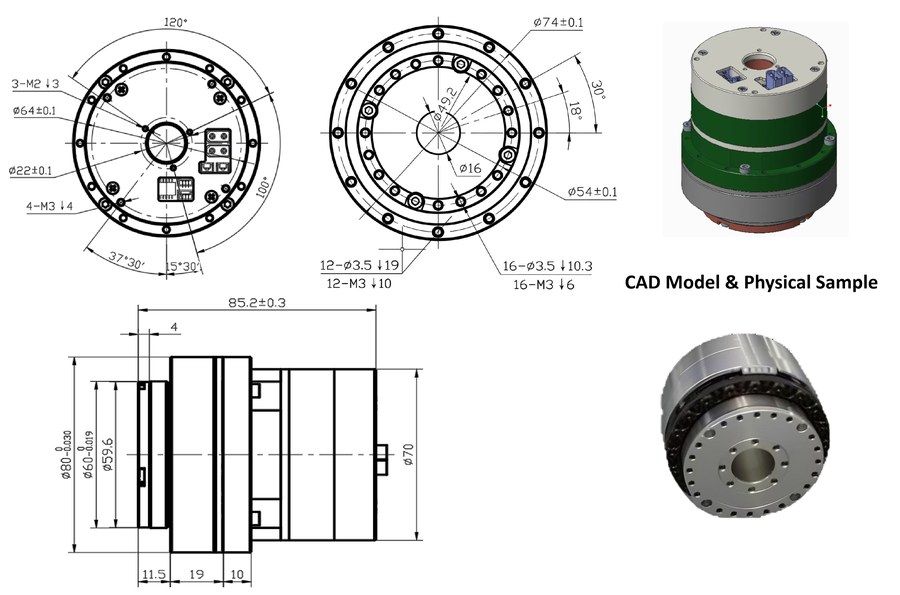
Our High-Precision Joint Module is the bigger sibling to the Robot Dog Joint Module, designed for the torque demands of humanoid robot joints and the precision requirements of collaborative arm axes.
Why a 48 V Harmonic-Driven Module
Humanoid knees, ankles and shoulders need both high torque (to lift and accelerate limbs against gravity) and high precision (to control contact forces with the environment). A 48 V bus lets us push higher current through smaller cables, and a harmonic reducer gives us the 100:1 gear reduction needed to multiply motor torque without adding backlash.
Key Specifications
| Weight | ≤1,500 g |
| Supply voltage | 48 V DC |
| Rated current | 4.0 A · peak 15.0 A |
| Rated output torque | 45 N·m · peak 145 N·m |
| Reducer ratio | ≥100:1 harmonic |
| Encoder | Dual 24-bit magnetic encoders |
| Rated speed | ≥30 rpm · no-load ≥45 rpm |
| Repeatability | ≤0.01° (closed-loop) |
| Operating temperature | −20 °C to +70 °C |
Mechanical Interface
- Standard 14 mm output shaft with keyway.
- M5 mounting pattern on housing flange.
- Sealed to IP65.
- Optional integrated brake for vertical-axis applications.
Control Interface
- CAN bus (default) or EtherCAT on request.
- FOC with field-oriented torque control.
- Profile position, velocity and torque modes.
- Configurable safety limits (position, velocity, torque).
- Real-time current and temperature feedback.
Typical Applications
- Humanoid robot knee and ankle joints.
- Collaborative arm shoulder and elbow axes.
- Surgical robot positioning stages.
- High-precision pick-and-place axes in semiconductor assembly.
Engineering samples are available now. Volume production lead time is 6–8 weeks. Please contact us with your project specification — we will review your application and recommend the right configuration.