
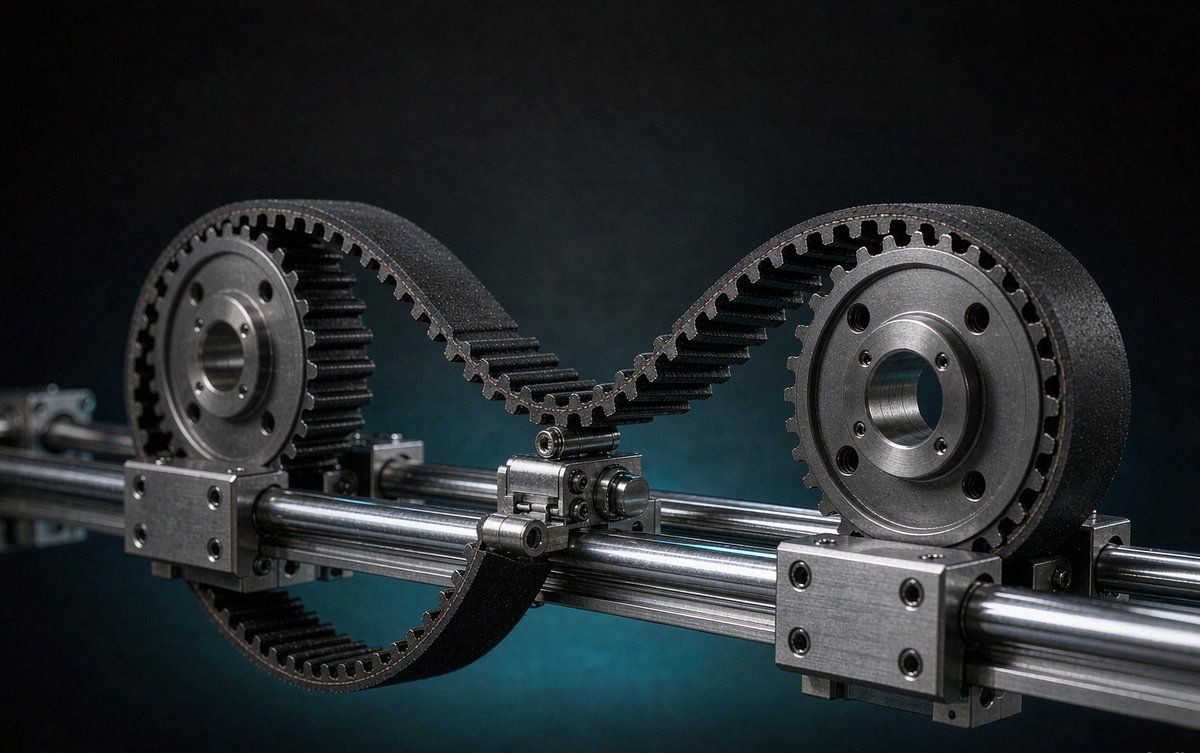
For linear motion engineers, the timing-belt clamp plate is one of those components that looks simple but determines whether your system runs quietly for years or fails within months. Most sourcing mistakes happen not because the plate is wrong, but because the pitch profile was mismatched to the belt from the start.
Why Pitch Matters More Than Length
Belt manufacturers publish their pitch in millimeters or inches — XL 5.08 mm, L 9.525 mm, H 12.7 mm, T5 / T10, AT5 / AT10, HTD 3M / 5M / 8M / 14M. If your clamp plate has a 5.08 mm groove but the actual belt is an XL037 (5.08 mm pitch, 9.5 mm width), the teeth will mesh correctly. Switch to L050 by accident (9.525 mm pitch) and the teeth cannot seat at all — the belt will walk sideways within minutes under load.
The Three Load Conditions That Break Plates
- Continuous tension — drives running 8+ hours a day, especially in packaging or printing lines. Look for plates with reinforced side walls.
- Shock load — pick-and-place axes, indexing tables. The plate needs even clamping force across both edges.
- Reversing duty — bidirectional travel. Pitch parallelism becomes critical; off-axis loading will strip teeth within weeks.
Profile Families We Stock
- XL / L / H (imperial trapezoidal) — the legacy standard for CNC retrofit and automation upgrades; widely available globally.
- HTD 3M / 5M / 8M / 14M — high torque drive, curvilinear tooth, preferred for new linear axes.
- T / AT (T5 / T10, AT5 / AT10) — zero-backlash precision, common in semiconductor and medical equipment.
We carry all six families in 36 standard sizes. Custom profiles and OEM sizes typically ship in 15–20 working days.
Quick Checklist Before You Order
- Confirm pitch with vernier calipers on a flat section of belt.
- Match the belt manufacturer brand — Continental / Gates / Bando / Optibelt tolerances add up.
- Specify belt width — the "L" dimension in our chart is the maximum belt width, not the minimum.
- For 24/7 operation, choose the larger S (thickness) variant in the same family.
If you are retrofitting an existing drive, send us the failed plate or the belt drawing — we can usually identify the correct pitch family within five minutes.