
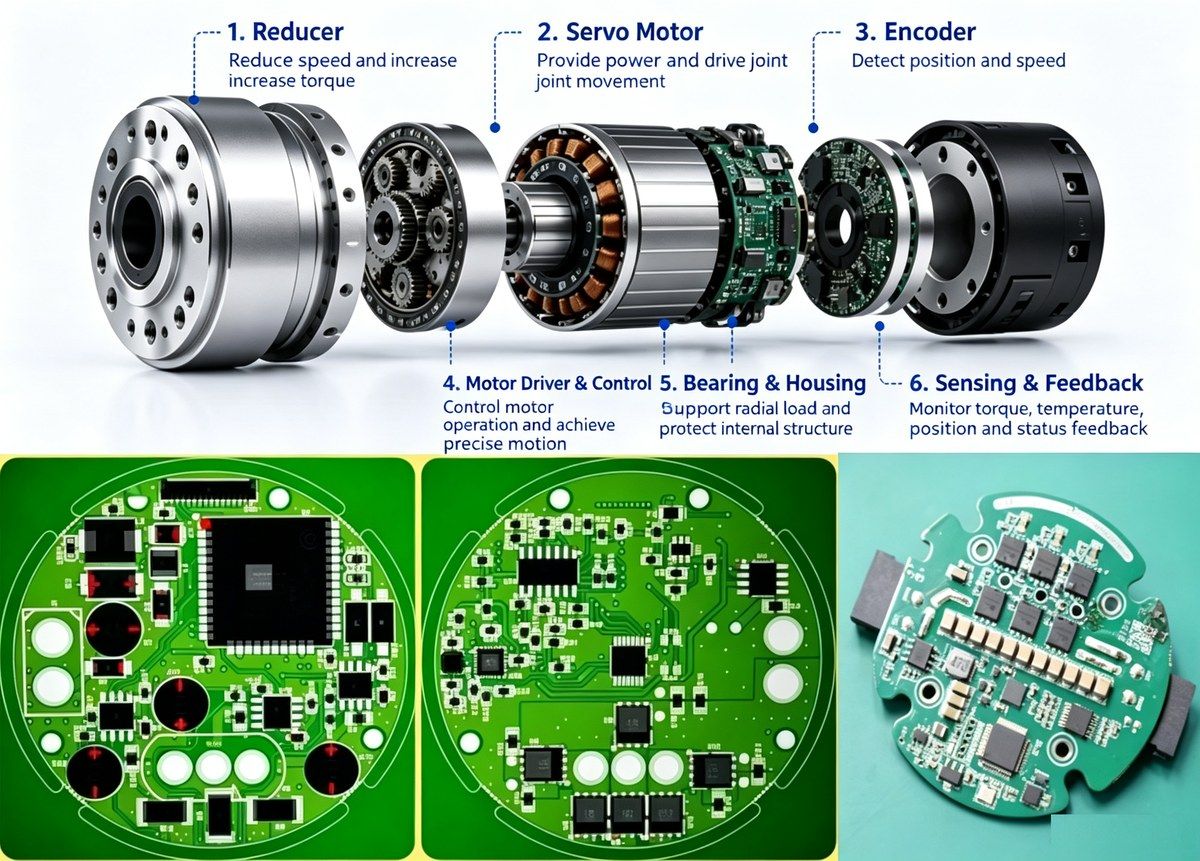
Walk through any humanoid robotics lab in 2026 and you will see the same architectural shift: teams are moving away from "motor + cable + external driver + separate reducer" stacks and toward integrated joint modules. The reason is not marketing — it is measurable engineering gains.
The Discrete Architecture Problem
A traditional robot joint is five separate parts: a brushless servo motor, a planetary or harmonic reducer, an encoder, a driver board, and a CAN / EtherCAT cable harness. Each interface is a tolerance stack, a connector failure point, and a cable that takes up routing space.
For a quadruped robot with 12 joints, that is 12 power cables (motor phases), 12 communication cables (encoder + driver), 12 motor driver PCBs, and 12 reducers that have to be aligned one by one.
What "Integrated" Actually Means
| Subsystem | Discrete | Integrated |
|---|---|---|
| Motor | External BLDC | Frameless torque motor inside housing |
| Reducer | External planetary / harmonic | Sealed planetary or harmonic inside |
| Encoder | External, motor shaft | Dual magnetic encoders on both shafts |
| Driver | External servo drive | FOC drive electronics integrated |
| Communication | 4-wire harness to drive | CAN / RS485 single bus |
Measurable Wins for Robot Designers
- Weight — a 24 V 3 N·m class discrete servo weighs 380–450 g; our Robot Dog Joint Module weighs ≤220 g in the same torque class.
- Wiring — from ~12 conductors per joint to 2 conductors (power + bus).
- Backlash — sealed preloaded harmonic or planetary reducer cuts backlash from 15–30 arc-min to ≤5 arc-min.
- Assembly time — one bolted joint instead of five alignment steps.
Where Discrete Still Makes Sense
Very large industrial axes above 5 kW peak, systems where the reducer must be field-replaceable, or applications that already have a centralized cabinet and long cable runs. For those, a discrete architecture still has engineering merit.
The tradeoff to plan for: integrated modules concentrate heat in a smaller volume. Always spec the duty cycle — a 145 N·m peak is meant for acceleration, not steady state.